At a Glance
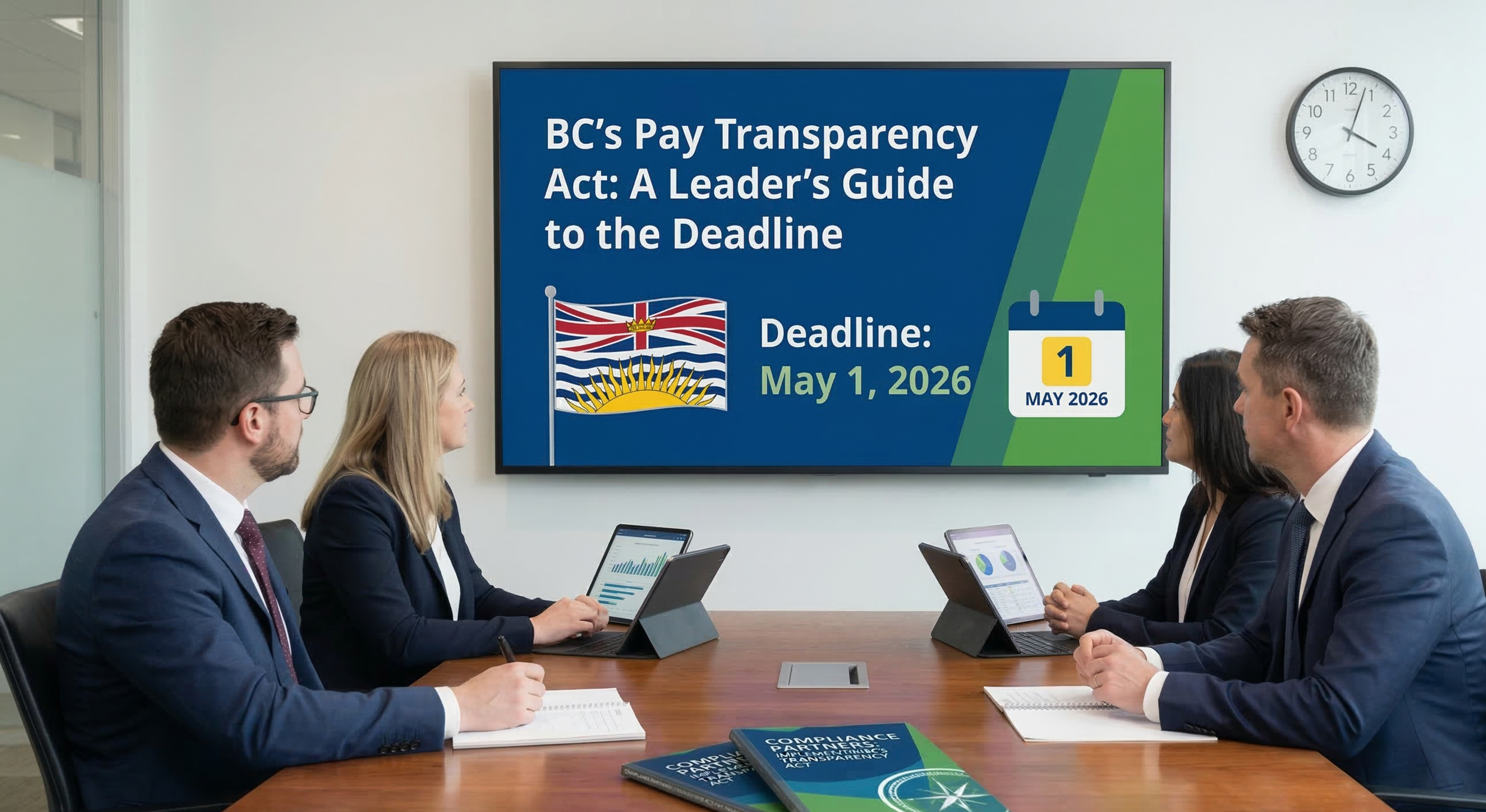
On November 1, 2026, all BC employers with 50 or more employees must publish their first pay transparency report — the final phase of a four-year rollout of the BC Pay Transparency Act. The legal mechanics are well-defined. The harder questions are operational: what does your data actually show, can you explain it credibly, and is your organization prepared for the moment the report goes public?
The Deadline That Looks Smaller Than It Is
It is spring 2026. Your organization has 78 employees in BC. Last year you watched larger employers publish their first pay transparency reports, and the topic flickered in and out of leadership conversations a few times. Then other priorities took over.
This is happening alongside a broader wave of BC workplace law changes. BC employment standards, WorkSafeBC rules, and other compliance obligations have all moved over the past two years, and the November 1, 2026 deadline sits in the middle of that wave.
In November, your organization will need to publish a report that shows differences in pay between gender categories across your workforce. The report will be public. It will live on your website. Your employees will read it. So might prospective hires, funders, journalists, and competitors.
The deadline itself is not difficult to meet. The BC government has built a free Pay Transparency Reporting Tool. If you have payroll data and the time to organize it, you can file the report in a single afternoon.
That is not the work that matters. The work that matters is what your data is going to show, and whether your organization has any preparation behind that data — or whether the report will be the first time anyone in your leadership team sees the gender pay gap in your own workforce, with no time to do anything about it. For the full provincial picture, see the companion piece, BC's gender pay gap: who the average leaves behind. This guide focuses on the operational work: what to do, and when.
The Core Principle
Pay transparency reporting is not the moment you find out what your pay structure looks like. It is the moment everyone else does. Your own work should begin months earlier.
A pay transparency report is a compliance deliverable. The decisions it reveals — about hiring, compensation, promotion, and the choices made over years — are not. The leaders who handle this well are not the ones who file the most polished report. They are the ones who looked at the data months earlier, and identified what it would reveal; they either adjusted what they could or built a clear, honest explanation for what they could not.
What the BC Pay Transparency Act Actually Requires
The BC Pay Transparency Act came into force on May 11, 2023. For broader context on the Act's job-posting, pay-history, and pay-secrecy rules beyond annual reporting, see our leader's guide to the BC Pay Transparency Act. The reporting requirement was phased in based on employer size, with each phase using the headcount as of January 1 of the reporting year:
November 1, 2023: BC Public Service and the six largest Crown corporations.
November 1, 2024: employers with 1,000 or more employees.
November 1, 2025: employers with 300 or more employees.
November 1, 2026: employers with 50 or more employees — the final scheduled phase, and the largest by far, bringing roughly 8,500 BC employers into scope.
Two important details about who is in scope:
BC employees only.
What the Report Must Contain
The Pay Transparency Regulation specifies what the report must include. The core required elements are:
Checklist
- Employer name, mailing address, and applicable NAICS sector code.
- The reporting period (a 12-month window of your choice — most recently completed calendar year or fiscal year).
- The number of BC employees as of January 1 of the reporting year, expressed as a range.
- A breakdown of pay across four gender categories: Man, Woman, Non-binary, and Unknown.
- The difference in mean and median hourly pay between each gender category and the reference category (typically Man).
- The difference in mean and median overtime pay and bonus pay between each gender category.
- The percentage of each gender category that received overtime pay or bonus pay during the period.
- A ranking of all employees by hourly pay, divided into four equal pay quartiles, showing the percentage of each gender category in each quartile.
If a gender category has fewer than 10 employees, certain breakdowns are suppressed for privacy reasons. In many small organizations, only the Man and Woman categories will have enough people to produce meaningful comparator data.
Where the report goes: The completed report must be published on a publicly accessible website. If your organization does not have a public website, copies must be made available to employees at the workplace and to any member of the public on request. The report stays public for one year, and the cycle repeats every November 1.
What Most Employers Underestimate
Reading the legal requirements, the preparation looks small: a list of fields, a free reporting tool, a CSV upload, a published page. In practice, four things take longer than expected.
Collecting gender information. The Act requires employers to collect gender information from employees for the report. Collection is voluntary for employees (declined responses go under Unknown), but the collection itself must happen — with a clear notice, documented purpose, secure storage, and self-identification (not manager guessing), in compliance with PIPA (private) or FOIPPA (public). For organizations that have not previously collected gender information, this typically takes one to three months.
Preparing the pay data. The reporting tool needs hourly pay, hours worked, ordinary pay, overtime hours, overtime pay, and bonus pay for every BC employee in the period. For organizations using basic payroll software, spreadsheets, or a mix of systems, the cleanup is significant: reconciling employees across systems, mapping pay components, distinguishing salary and special salary, handling part-time and seasonal workers, reconstructing data for mid-period hirees and departures. This can take a 50-employee organization a month of focused work.
Understanding what the numbers will show. The report reveals nothing new; it just makes existing patterns public. For most organizations, this will be the first time leadership sees pay broken down by gender across the entire workforce. Understanding what a gap reflects — and what, if anything, to do about it — takes weeks. Sometimes months.
Preparing the communications. The report will be public. Employees, funders, board members, journalists, and competitors will read it. It needs to land alongside an internal communications plan, manager talking points, and an honest explanation of the organization's pay-equity work. This is not a task that waits until after filing — it is part of the report's work.
The Readiness Checklist
Working backwards from November 1, 2026
The Hard Truth: The Report Is Not the Risk
The Pay Transparency Act currently lacks financial penalties for non-compliance; failure to file results in being listed in the province's annual report. It relies on public transparency rather than fines or inspections.
The real risk is reputational—since the report will be public, read by funders, job candidates, employees, journalists, and competitors. If it reveals a pay gap with no explanation, silence can hurt credibility.
Providing thoughtful context turns the report into an opportunity to demonstrate transparency and address concerns. The focus before November 1 is not on avoiding fines but shaping what the report says about your organization.
What to Do If Your Data Looks Bad
Most BC organizations will see a gender pay gap when they run their first report. Among the 300-plus employee organizations that reported in the most recent wave, half paid men at least 5% more than women. A gap of that scale, or even larger at the employer level, is common. For the full provincial picture — including how the gap differs for racialized, Indigenous, and newcomer women — see BC's gender pay gap: who the average leaves behind.
If your draft data shows a meaningful gap, you have three honest options.
Option 1: Adjust what you can. If you find within-role pay gaps that you cannot defend — two employees in the same role with similar tenure and performance, paid materially different amounts — you can address those before the next reporting period. This will not change the report you file in November (that period is closed), but it changes the trajectory for year two and shows good-faith action when employees ask.
Option 2: Explain honestly. If the gap reflects role-mix issues — senior roles mostly held by men, lower-paid roles mostly by women — the report will show that, and an honest explanation acknowledges it. The strongest responses pair the report with a brief contextualizing statement, ideally as part of an integrated Total Rewards Strategy. For organizations moving lower-paid roles toward a regional living wage, our Living Wage Employer guide walks through how to phase that transition.
Option 3: Do nothing. This is the option most organizations default to, and it creates the most reputational risk. Filing without internal acknowledgment, a communication plan, or a forward-looking statement is technically compliant. It also reads, to anyone paying attention, as an organization that did not plan. The defensible version is intentional silence: a complete report, no commentary, but a documented internal leadership discussion so that when employees or board members raise questions, the answers are ready.
Common Mistakes to Avoid
- Treating the report as a payroll task instead of a leadership task.
- Starting in September — collection of gender information alone takes weeks.
- Forgetting that the report is public and being surprised when people read it.
- Skipping the data review before filing (the single most common year-one mistake).
- Over-explaining in the report itself — keep the optional employer statement brief and honest.
- Asking managers to guess gender — the Act requires self-identification.
- Forgetting about year two — the report is annual, and year one is the foundation.
- Assuming federally regulated status without confirming it.
- Treating compliance as the ceiling instead of the floor.
Aurora's Perspective
We work with BC employers new to pay transparency reporting, mostly with 50-200 employees, limited HR capacity, and leadership unfamiliar with gender perspective in compensation data. Our approach is simple: confirm scope, collect data properly, prepare the draft early, review findings, and guide leadership on actions. Companies that manage initial reports smoothly reduce future anxiety. Year two becomes a routine check, not a crisis. Those who go beyond mere compliance treat pay transparency as a pay equity effort, positioning themselves well for future requirements.
This article is general HR and compliance guidance, not legal advice. Employers with questions about whether the Act applies to their specific situation should consult qualified legal counsel.
Want to know what your November 1, 2026 report is going to say — before you file it?
We help BC employers with 50 or more staff run a draft of their pay transparency report months before the deadline, identify what the data reveals, and decide on a credible response.
Let's Talk