
Total Rewards Strategy Consulting
for BC Organizations
Compete on value, not just salary, with a rewards strategy that reflects your values.
At Aurora HR, we believe that how you compensate people is one of the clearest signals your organization sends — about what it values, who it invests in, and whether fairness is a principle or a talking point. Every pay decision, every salary band, every benefits choice tells your workforce something about how they are seen. Not just as roles to be filled, but as people whose contributions either matter visibly or get taken for granted quietly.
DONE WELL, A TOTAL REWARDS STRATEGY DOES MORE THAN ATTRACT TALENT. IT REFLECTS YOUR VALUES, SUPPORTS DEFENSIBLE DECISIONS, AND GIVES YOUR PEOPLE A REASON TO STAY.
IS YOUR REWARDS STRATEGY SAYING WHAT YOU INTEND IT TO SAY?
Do your employees see their contributions reflected in how they are compensated — or do they wonder whether anyone notices?
Are pay decisions made through clear, defensible criteria, or do negotiation history, timing, and advocacy shape outcomes more than performance?
Can you explain why two people in similar roles earn different amounts — and would that explanation hold up publicly?
These are not compensation questions. They are leadership questions about trust, fairness, and whether the organization you are building can sustain the people who are building it. Aurora HR helps you design a total rewards strategy that balances values, equity, and sustainability — and gives your people a reason to stay.
Together, we build a rewards strategy your people can see, understand, and trust.
The Value Gap
Compensation practices in most organizations are not designed; they accumulate. Pay decisions get made one at a time: a counteroffer here, an adjustment there, a new hire brought in above the band because the market moved. Over time, the result is a patchwork that is difficult to explain, harder to defend, and increasingly visible to employees who are paying closer attention than most leaders realize.
Compensation tells your workforce — every pay period — whether fairness is a principle or a talking point. A clear rewards strategy makes that answer deliberate, not accidental.
The challenge is rarely that leaders do not care about fairness. It is that pay decisions are often made reactively — under time pressure, without consistent criteria, and without visibility into how individual choices accumulate into organizational patterns. The result is wage compression between levels, pay gaps between similar roles that no one can fully explain, and a growing distance between what leaders intend and what employees experience.
At the same time, every organization carries a different financial reality. Some face funding constraints. Others are working toward living wage commitments. Many are balancing rising costs with the need to retain experienced people. There is no single formula — but there is always a way to bring more structure, transparency, and fairness to how rewards decisions are made.
We help you build a total rewards strategy that reflects your values and your constraints honestly — from compensation philosophy to salary structure, pay equity analysis, and the communication tools that help employees see the full picture of what they receive.
Landscape and Opportunity
The Transparency Risk
Employers with 300+ employees must publish annual pay transparency reports by Nov 1, 2025; those with 50+ employees by Nov 1, 2026. Reporting gender pay gaps is mandatory.
When minimum wage rises but higher levels do not adjust proportionally, the distance between pay grades shrinks — sometimes to the point where new hires earn nearly as much as experienced employees. This erodes perceived fairness, reduces incentive for advancement, and quietly tells long-tenured people that loyalty is not rewarded.
Most organizations communicate compensation at the point of hire — and then rarely again. Employees are left to judge their total value based on a salary line and whatever they hear from colleagues or job postings. Without total rewards communication, your people may assume they receive less than they actually do.
When compensation decisions are made without consistent criteria — when the answer depends on who is asking, who is negotiating, or what the market was doing at the time of hire — leaders carry risk they may not fully see. Every inconsistent decision becomes harder to explain and harder to reverse. A clear rewards framework gives leaders a defensible basis for the judgment they are already exercising.
Our Solutions
We build strategies across four key areas:
- Compensation philosophy development
- Pay grade and salary structure design
- Internal equity vs. external competitiveness
- Job evaluation methodology
- BC market compensation data analysis
- Sector-specific benchmarking
- Geographic adjustments
- Pay equity analysis (identifying gaps)
- Pay Transparency Act reporting
- Wage compression remediation
- Total Rewards Statements for employees
- Manager training on compensation conversations
- Candidate value proposition materials
Our Process
Rewards Discovery & Data Collection
We start by building a clear picture of your current rewards reality — not just what people are paid, but how those decisions were made, where consistency breaks down, and what risks may already be accumulating quietly.
- Collect and organize pay, role, and benefits data across the organization
- Benchmark compensation against relevant BC and sector-specific market data
- Assess internal equity risks and identify indefensible pay gaps
- Review total rewards value including benefits, flexibility, and non-cash elements
Rewards Discovery & Data Collection
We start by building a clear picture of your current rewards reality — not just what people are paid, but how those decisions were made, where consistency breaks down, and what risks may already be accumulating quietly.
- Collect and organize pay, role, and benefits data across the organization
- Benchmark compensation against relevant BC and sector-specific market data
- Assess internal equity risks and identify indefensible pay gaps
- Review total rewards value including benefits, flexibility, and non-cash elements
Design & Architecture
With a clear picture of where things stand, we design the structure that brings consistency and defensibility to your compensation decisions — reflecting your values, your financial reality, and the transparency your workforce and B.C. law now expect.
- Design job levels and salary bands with clear progression logic
- Develop a compensation philosophy that reflects your values and constraints
- Create pay decision guidelines managers can apply consistently
- Build the structural foundation for Pay Transparency Act compliance
Rollout & Governance
Structure only works if people trust it. We support rollout with communication tools, manager training, and governance processes that keep the system fair and current over time.
- Develop total rewards statements showing employees their full compensation value
- Train managers on compensation conversations and pay decision rationale
- Create governance processes for ongoing review, adjustments, and market checks
- Build communication materials that support transparency and trust
Frequently Asked Questions
Does Your HRIS Track Total Rewards?
Most platforms handle payroll — but can yours communicate the full value of what employees receive? Our free HRIS Assessment Tool helps you evaluate vendor capabilities for benefits, compensation analytics, and total rewards reporting.
Evaluate Your HRISHighly Credentialed HR Partner
- Advise executives on compensation strategy and pay governance.
- Certified compensation expertise supporting competitive and equitable pay.
- Design compensation frameworks aligned with organizational strategy.
Working Style
Data-informed compensation decisions aligned with business goals.
Best Fit
Pay decisions feel inconsistent or reactive
Organizations reviewing compensation fairness
Leaders preparing for pay transparency expectations
Highly Credentialed HR Partner
Our team holds some of Canada's and North America's most respected senior credentials in human resources, strategic people leadership, and workplace advisory.





A direct conversation with a senior HR consultant — no sales pitch, no pressure.
What You Walk Away With
Concrete deliverables that provide clear, objective standards for your organization.
Compensation Philosophy
Written statement of market positioning and equity principles.
Salary Structure
Pay grades with ranges and midpoints for all positions.
BC Market Benchmarking
Analysis of relevant market data for your sector and geography.
Pay Equity Analysis
Detailed analysis identifying pay gaps with remediation recommendations.
Total Rewards Statements
Individual employee statements showing complete value.
Manager Toolkit
Guides for supervisors handling compensation discussions.
Ready to Compete on Total Value?
You offer more than salary. Help candidates and employees see the complete picture of what you provide.
Related Insights

BC's Gender Pay Gap — 2026 Update: Who is Left Behind
BC's headline gender pay gap is 14.5%. Behind that single number sit gaps nearly double for some groups of women. Here is a fuller picture of why the gap persists, beyond the average.
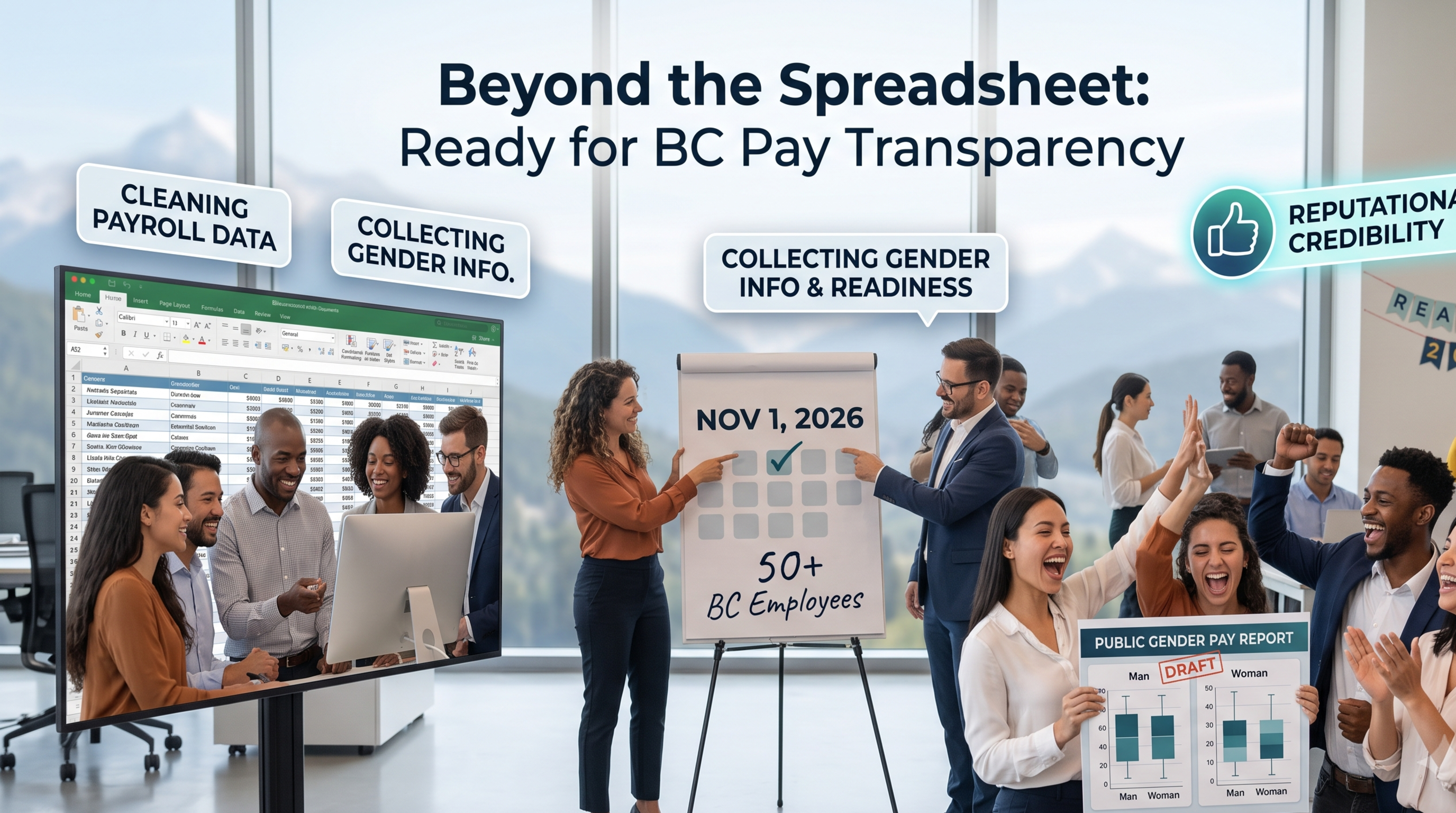
BC Pay Transparency Reporting for Employers with 50+ Employees
If you have 50 or more employees in BC, your first pay transparency report is due November 1, 2026. The legal requirement is straightforward. The preparation work is not. Here is how to get ready, in the months you actually have.

Stay Interviews: The Conversation That Keeps Your Best People
A Langley manufacturer loses two $110K project managers in a quarter. The exit interviews are candid — and every reason arrived exactly when it was useless. Stay interviews change that.