Skip to content
Pay Equity & Compensation

BC's Gender Pay Gap — 2026 Update: Who the Average Leaves Behind

The headline is 14.5%, and it is improving. But an average is a poor description of who actually gets paid what. Behind it sit much wider gaps, and a set of forces worth naming plainly.

The 2026 update on BC's gender pay gap, beyond the average

10 min readPublished June 2, 2026
Share

At a Glance

BC's gender pay gap narrowed to 14.5% in 2025, down from 18.4% before the Pay Transparency Act. That is genuine progress. But a single province-wide average flattens a much more uneven reality. Recent newcomer women earned 69 cents for every dollar a Canadian-born man earned. Racialized women earned 74 cents. The gap is not one number. It is many, and the widest ones belong to the people with the least bargaining power.This piece looks past the headline at three things the average hides: who the gap actually falls hardest on, why equal-pay rules only address part of the problem, and how everyday pay-setting decisions quietly widen the gap.

What Three Years of Reports Show

Since the Pay Transparency Act came into force in 2023, the BC government has published an annual report on the province's gender pay gap. Three are now out, each covering the previous calendar year. Read together, they tell two stories at once: a headline number that is slowly improving, and a set of underlying gaps that are not improving nearly as fast — and in some cases are getting worse.

The Three Reports at a Glance

ReportPublishedData yearHeadline gapEmployer wave (filed Nov 1)
FirstJune 2024202317%Public Service + 6 Crown corporations
SecondSept 2025202415.3%1,000+ employees (~80% filed)
ThirdJune 2026202514.5%300+ employees (~64% filed)

The Headline: Real Progress, Slowly

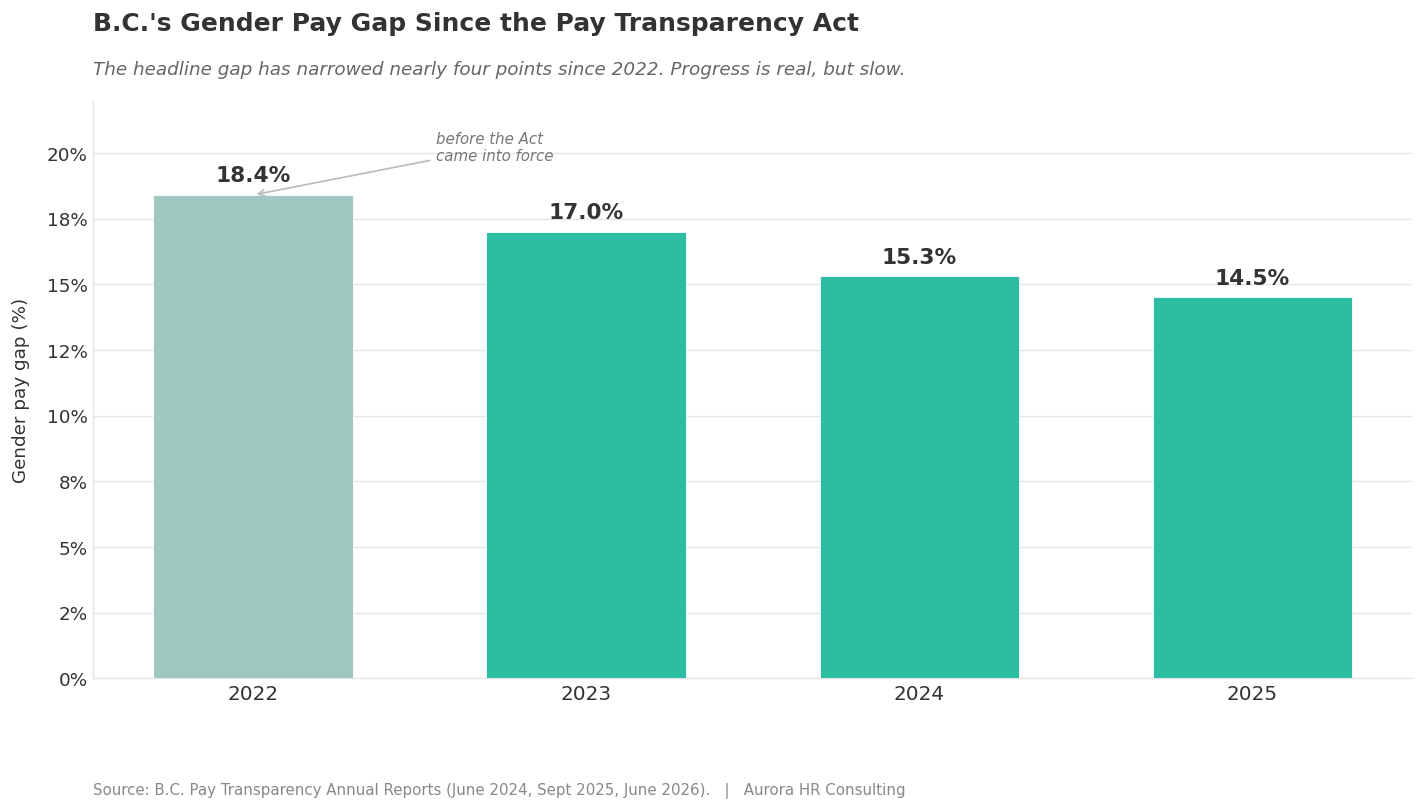
The third annual report, released June 2026, confirmed a steady downward trend. Before the Act came into force in 2022, women in BC earned 18.4% less than men based on median hourly wages. By 2025 that gap had narrowed to 14.5%, meaning women earned about 85 cents for every dollar men earned. A nearly four-point improvement in three years is worth acknowledging.B.C.'s headline gender pay gap, 2022 to 2025. Down from 18.4% before the Act to 14.5% in 2025. Source: B.C. Pay Transparency Annual Reports (2024, 2025, 2026).Two caveats keep that progress in perspective. It is slow — roughly a point a year, which on the current trajectory would take more than a decade to close. And despite the improvement, BC still had the third-highest gender pay gap of any Canadian province in 2025 (14.5% against a national figure of 12.6%). The headline is moving in the right direction. It is also still an outlier.

The Average Is the Wrong Number to Watch

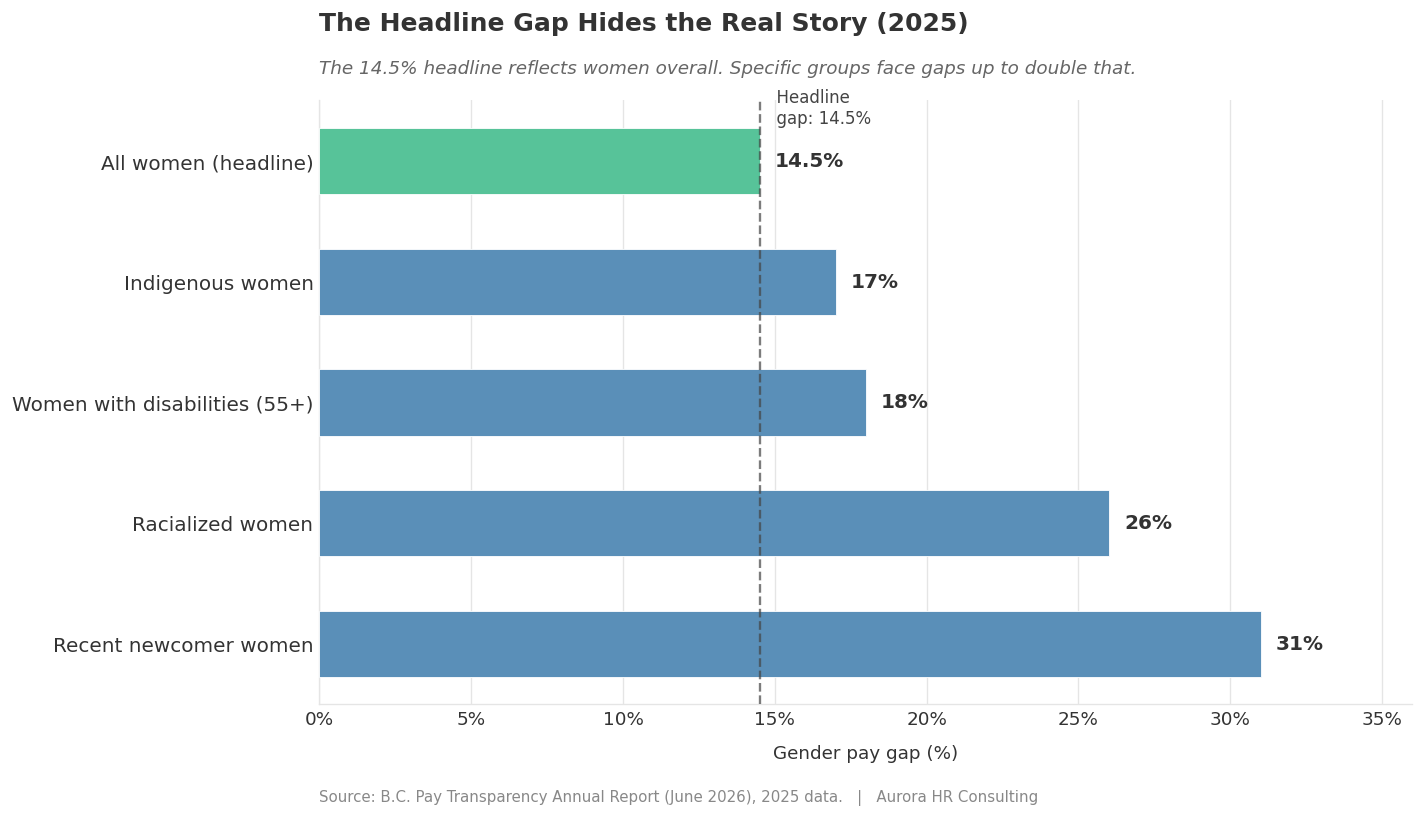
Here is the heart of it. The 14.5% figure describes women as one undifferentiated group. The moment you break it apart, the average stops being a useful description of anyone. Some groups of women sit close to it. Others sit nearly twice as far behind.Gender pay gaps in B.C. by group, 2025. The 14.5% headline reflects women overall; recent newcomer women face a gap more than double that. Source: B.C. Pay Transparency Annual Report (June 2026).What the breakdown shows for 2025:Indigenous women faced a 17% gap, an improvement from 19% the year before.Women aged 55 and over with disabilities earned 18% less than men without disabilities in 2024 — an improvement of seven points from the year before.Racialized women faced a 26% gap, earning 74 cents for every dollar non-racialized men earned — despite holding higher average levels of education than non-racialized men.Recent newcomer women faced a 31% gap, the widest of any group measured. They earned just 69 cents on the dollar, and that gap widened by four points from the previous year.The pattern is consistent across every report: the further a group sits from the demographic majority, the wider the gap; and the more education a group has relative to its pay, the more visible the disconnect. Racialized and newcomer women in BC are, on average, highly educated and concentrated in lower-paid work. That combination is the clearest signal that the gap is not mostly about qualifications.
Equal Pay Is the Easy Part. Equal Value Is the Hard One.

The Pay Transparency Act, and most of the public conversation around it, is built on pay equality: two people doing the same job should be paid the same. That is the easy part, and it is largely settled in principle. As we noted in our leader's guide to the Act, the Act opens the door to a harder conversation it does not actually resolve: pay equity, the principle that work of equal value should be paid equally, even when the jobs are different.This distinction explains most of the gap the headline number cannot. Very few BC employers today pay a woman less than a man for the identical role; that would be both obvious and indefensible. The gap persists because women and men are concentrated in different kinds of work, and the work that women do is systematically valued less, even when the skill, responsibility, and demand are comparable.

Early Childhood Education: A Case in Point

Consider early childhood education. It is among the most demanding and consequential work in the economy — caring for and developing young children requires training, patience, judgment, and enormous responsibility for safety and wellbeing. It is also overwhelmingly performed by women, and it is paid far below trades or technical roles that require comparable training time. No one decided, in a single moment, that ECE should be underpaid. It is underpaid because the labour market has long treated care work as worth less, and because the workforce doing it has had little leverage to argue otherwise.An equal-pay lens cannot see this gap at all, because there is no higher-paid man doing the identical ECE job to compare against. Only an equal-value lens can: it asks whether a role demanding this much skill and carrying this much responsibility is paid in line with comparably demanding roles elsewhere. Across BC's female-dominated sectors — from child care to home support to administrative work — the answer is repeatedly no. That is where a large share of the headline gap actually lives.

How the Gap Gets Set, One Hire at a Time

The data describes the gap at the level of the province. But pay is not set at the level of the province. It is set one offer at a time, in thousands of individual hiring decisions — and a few ordinary dynamics in those decisions quietly widen the gap whether anyone intends it or not.In our work with BC employers, one pattern comes up again and again. A candidate who is new to the market — a recent newcomer, someone early in their career, someone who needs the job more than the employer needs them — will accept a lower rate. Not because they are worth less, and often despite strong experience or credentials earned elsewhere, but because their bargaining position is weaker. The rate they accept then becomes their floor. The next raise is a percentage of a number that started too low. Years later, the gap is still there, compounded, and no one along the way did anything that felt unfair in the moment.This is worth naming plainly because it is so easy to miss. It is not a story of bad actors. It is a story of how a market sets prices when bargaining power is unequal, and it helps explain why the newcomer-women gap in the data is the widest of all — and why it widened in 2025.Recognizing the dynamic is the first step to designing around it: structured pay ranges, offers anchored to the role rather than to what the candidate will accept, and periodic equity reviews that catch the compounding before it hardens.It also connects to the bottom of the wage scale more broadly. Where the floor itself is low, the same dynamics play out with even less room to absorb them — a theme we explore in BC minimum wage increases and pay compression and in becoming a living wage employer.

Is the Reporting Framework Helping?

The Pay Transparency Act takes an educational approach: it requires employers to measure and publish their gaps, on the theory that visibility drives change. On the evidence so far, that theory is partly working. The clearest win is job postings — by March 2026, 81% of BC postings included pay information, against 56% across Canada. A behaviour shift that was hard to imagine before the Act, and one that directly strengthens the bargaining position of the candidates described above.The limits are also clear. The Act requires reporting but not remediation, so an employer can publish the same wide gap year after year and remain fully compliant. Employer compliance with the reporting requirement itself slipped to about 64% in the most recent wave, down from roughly 80% in the previous one. And because the gaps that matter most are equal-value gaps rooted in which sectors people work in, a tool focused on within-employer comparison can describe them but cannot, on its own, close them. The framework is a meaningful start. It is not the finish.

What This Means If You Have to File

On November 1, 2026, the reporting requirement reaches all BC employers with 50 or more employees — roughly 8,500 organizations, many reporting for the first time. If that is you, the patterns in this article are a preview of what your own numbers will likely show, and a guide to reading them honestly. Our companion piece, Pay Transparency Reporting in BC: Are You Ready for November 1?, walks through the operational steps and timeline.Two things this data should change about how you read your own report. First, do not stop at the headline figure — a modest overall gap can still hide a wide one for newcomer or racialized employees, so look at the breakdown. Second, expect much of the gap to be about which roles people hold, not unequal pay within a role. That is a representation and job-design question as much as a pay question, and naming it accurately is more credible — and more useful — than explaining it away.

Aurora's Perspective

From the practice

We read these reports as a map of where the work is, not as a scorecard. The headline progress is real and the transparency rules are doing some good. But the gaps that matter most — for newcomer, racialized, and Indigenous women, and for everyone doing undervalued work in female-dominated sectors — will not close on visibility alone.They close when employers build pay structures that value roles consistently, anchor offers to the work rather than to a candidate's bargaining position, and review pay for compounding inequities before they harden. That is the substance of a real Total Rewards Strategy, and it is where the average finally starts to mean something for the people it currently leaves behind.

At a Glance — Quick Reference

  • Headline gap (2025): 14.5%, down from 18.4% before the Act. Roughly a point a year — still third-widest of any province.
  • Behind the average: Recent newcomer women 31%; racialized women 26%; women with disabilities (55+) 18%; Indigenous women 17%.
  • The core distinction: Equal pay for the same job is largely settled. Equal pay for work of equal value, across different jobs, is where the real gap lives.
  • How it compounds: A low starting rate accepted from a weak bargaining position becomes a floor that every future raise builds on.
  • If you have to file: See the companion piece, BC Pay Transparency Reporting for Employers with 50+ Employees, for the operational steps.

Talk to an HR Consultant

Build pay that values the work.

Schedule a Free 45-Minute Fit Call