A Critical Point
Development plans tend to fail in one of two ways. They treat training as a single event for everyone, or as a perk for a few high-potentials. It is neither.
Real development runs in two directions at once. One is the level it operates at: the whole organization, a single department, or one person. The other is the moment in the employee lifecycle it has to serve: a new hire finding their feet, a manager facing their first accommodation request, a performance conversation that keeps getting put off, a termination that has to be handled with care. Plan for the levels and ignore the moments, and the costliest gaps, the ones that can become complaints, claims, and lost people, are often the ones left untrained.
Setting the Scene
In many BC organizations, training is typically conducted incidentally. A compliance session here, a conference someone asked to attend there, an onboarding checklist that may or may not get used. There is rarely a plan, and rarely a budget line that says “this is how our people grow.”
The cost is quiet but real.
The Core Principle
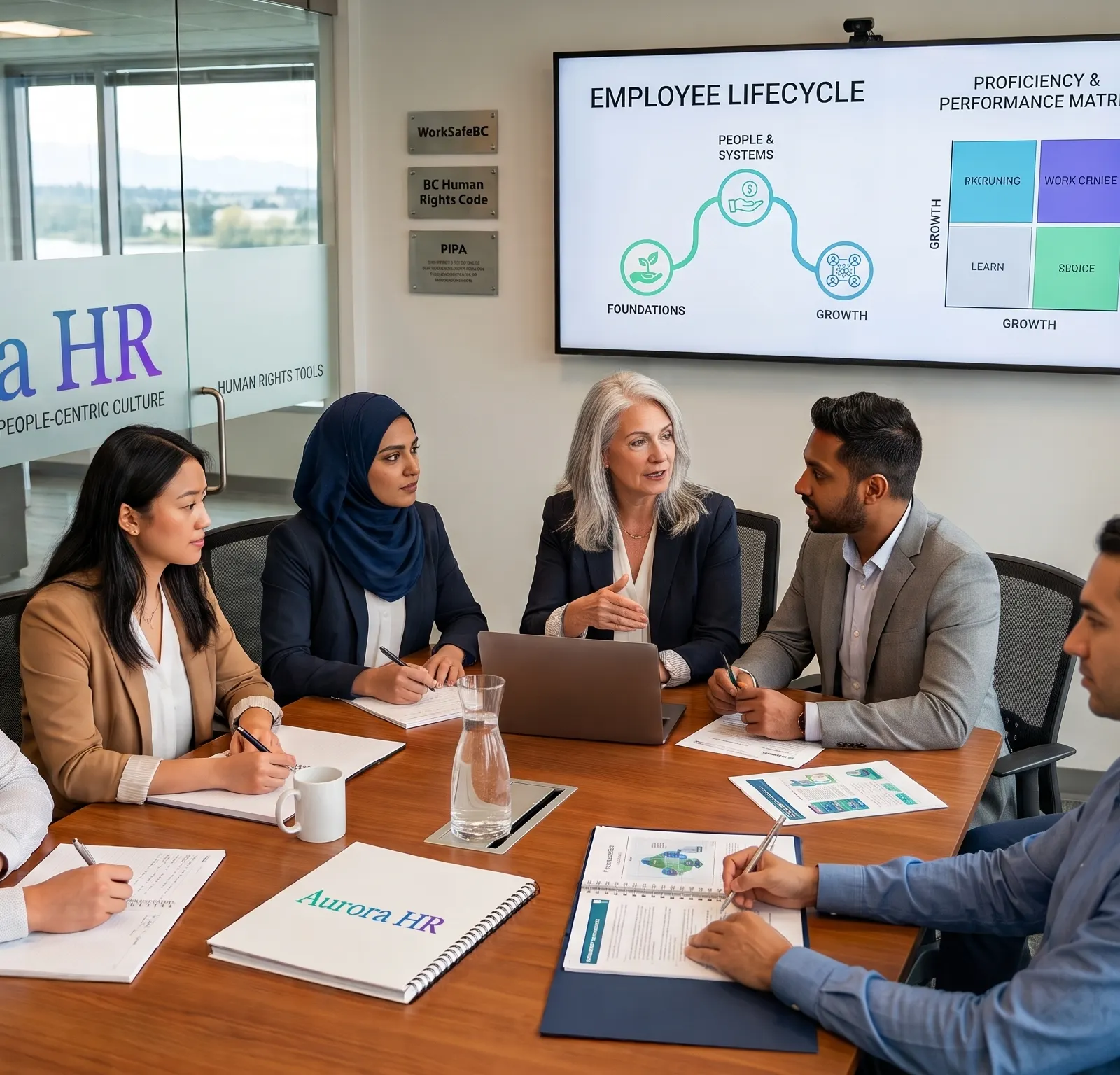
An employee development plan is a simple map of how your people will grow and how that growth serves the organization. Sometimes called an employee development strategy or framework, a good one is organized along two lines at once. The first is the three levels of who the training is for. The second is the employee lifecycle: the moments where training actually gets tested. Plot your training on both lines and the gaps become obvious. Think of it as a two-dimensional map: the three levels tell you who needs development, the lifecycle tells you when.
The Three Levels of Training
Training Every Person Needs
Swipe to see more →
| Training | Why it belongs here | Floor or baseline |
|---|---|---|
| Orientation to the organization | Mission, values, and how decisions actually get made | Baseline |
| WorkSafeBC health and safety orientation | Required before a worker starts the work, not in week three | Legal floor |
| Bullying and harassment | WorkSafeBC requires a policy, procedures, and that workers are informed of them | Legal floor |
| Respectful workplace and human rights | BC Human Rights Code applies to every worker and every interaction | Legal floor |
| Privacy basics | BC’s Personal Information Protection Act governs employee and client information | Legal floor |
| Confidentiality and client information | Client-serving and non-profit teams handle sensitive information daily | Baseline, floor in regulated sectors |
| Cybersecurity and phishing awareness | The most common breach starts with one person clicking one link | Baseline |
| Key policy orientation | Vacation, leaves, hours, overtime, expenses. People follow policies they were taught | Baseline |
| Conflict resolution basics | Everyone is in conflict eventually. Only managers get trained for it | Baseline |
| Diversity, inclusion and cultural safety | Ongoing practice rather than a one-off workshop | Baseline |
What Each Department Owns
Swipe to see more →
| Department | Examples of training that does not arrive with a new hire | What resets the need |
|---|---|---|
| Finance and accounting | Your bookkeeping system specifically, whether that is QuickBooks, Sage or Xero. Spreadsheet work past the basics. Fraud controls and segregation of duties | A funder or regulator changes reporting rules, or you change systems |
| IT | Your platform, not the category. Google Workspace and Microsoft 365 administer nothing alike. Phishing response and change management when systems shift | A migration, a new tool, or a breach anywhere in your sector |
| Frontline and program teams | Trauma-informed practice, de-escalation, boundaries with clients, and documenting a client interaction properly | A change in who you serve, or a serious incident |
| Fundraising and development | Your donor database, CRA receipting rules, and the reporting format each grant demands | A new grant, a CRA update, or a database change |
| Operations and warehouse | Equipment-specific safety, WHMIS, and certifications that expire on a schedule | New equipment, a near miss, or a certification coming due |
| Reception and client service | Privacy at the front desk, intake accuracy, and handling an upset caller | A privacy incident or a new intake process |
| HR and people | BC employment standards changes, investigation skills, and pay transparency reporting | Legislation changes, which in BC is close to annual |
None of this is exhaustive, and none of it is HR’s list to write. The job for each department lead is concrete: name the two or three capabilities the team needs next, and by when.
How People Grow
Swipe to see more →
| How people grow | Best for | What it costs |
|---|---|---|
| Stretch assignment | Someone ready for more scope before a title exists | Manager time, not budget |
| Job rotation | Cross-training and succession cover | Short-term productivity dip |
| Mentoring | Judgment and navigating the organization | A senior person's hours |
| Coaching | A specific skill gap or a new manager finding their feet | External fees or internal capacity |
| Shadowing | Understanding a role before moving into it | Almost nothing |
| Leading a project | Testing readiness for management | Real risk if unsupported |
| Formal training | Certification, compliance, technical depth | The visible budget line |
Training Across the Employee Lifecycle
The three levels tell you who. The employee lifecycle tells you when, and it is where the highest-stakes training usually hides, because almost all of it lands on one person: the manager. Each moment in an employee’s time with you carries a training need that is easy to skip until it goes wrong.
Lifecycle Moments and the Training They Demand
Swipe to see more →
| Lifecycle moment | Who needs training | What good training covers |
|---|---|---|
| Hiring and selection | The hiring manager | Structured interviews, the protected grounds, and fair, well-documented decisions |
| A new employee joins | New hire and their manager | The organizational floor delivered on time, plus how the work actually gets done here |
| Someone requests a leave | The manager | BC leave entitlements, how to respond, and what not to say |
| Someone requests accommodation | The manager | The duty to accommodate, engaging early, and documenting the process |
| Performance and reviews | The manager | Setting clear expectations, coaching and feedback, and documentation that holds up |
| Someone changes roles or is promoted | The employee and their new manager | The shift from doing to leading, new authority, and what the role now requires |
| A conflict or complaint surfaces | All staff and the manager | Reporting channels, responding to a complaint, and supporting a fair investigation |
| Discipline, termination, offboarding | The manager | Progressive discipline, a lawful and dignified exit, and clean offboarding |
Two of these create the most exposure. Under the BC Human Rights Code, the duty to accommodate can be triggered by an informal request, and a manager who treats it as a favour rather than an obligation creates real liability. Termination sits at the end of a chain that should begin with progressive discipline and a clear read on just cause and reasonable notice under the Bardal factors.
The People Who Make or Break It: Manager Training
If the lifecycle lands on managers, manager training is one of the highest-leverage investments in your whole plan. It splits into two very different needs.
First-time managers, including coordinators and volunteer leads who manage people without titles, face a tough career shift: from doing the work to enabling others. They're promoted for their skills, not for training in giving feedback, holding one-on-ones, or handling complaints.
Current managers need something different: not the basics, but updates as the law and the organization change, deeper coaching skills, and support with complex cases. When BC adds a leave, changes pay transparency rules, or you introduce a new policy, these managers carry it to the team, and they cannot carry what they were never told.
What that training covers, across the whole lifecycle, is laid out in What Every New People Leader in BC Needs to Know.
Budgeting Without a Training Department
You do not need a big budget or a learning platform to do this well. You need a small, deliberate line item and a plan for where it goes. A practical starting point for many smaller BC organizations is to fund the mandatory floor and onboarding first, give each department a modest request budget, and set a per-person development amount, even a few hundred dollars, that employees can use with manager sign-off. Even a small amount spent on purpose beats a larger amount spent reactively. Building the program itself follows a simple cycle: assess what is needed, design it, deliver it, and check whether it actually worked. None of that requires a dedicated department.
Patterns That Show Up Again and Again
- Treating orientation as paperwork instead of the first real training a person receives.
- Promoting strong individual contributors into management with no support.
- Skipping leave and accommodation training until a manager mishandles a request.
- Funding conferences for senior staff while the mandatory floor goes untrained.
- Writing a development plan once and never revisiting it as roles and people change.
What Leaders Are Navigating
Aurora HR Perspective
Aurora HR builds development plans for values-driven, growing BC employers, sized to their budget. We map training on both lines: the three levels and the lifecycle moments where risk is highest. We focus on managers, first-time and experienced, because that is where development compounds or quietly fails, and where an untrained response to a leave, an accommodation, or a termination becomes a claim. The result is a plan with clear ownership and purpose, tied to retention, capability, and lower risk.
Key Actions for Leaders
- Map your training on two lines: the three levels and the employee lifecycle.
- Lock the legal floor first: WorkSafeBC health and safety, bullying and harassment, respectful workplace and human rights, and privacy basics.
- Ask each department lead to name the two or three skills their team needs next, and by when.
- Train managers for the lifecycle moments, with separate tracks for first-time and experienced managers.
- For each person, write a one-page plan in the overlap between what the organization needs and what they want.
- Protect a small budget: fund the floor, give departments a request budget, and give individuals a modest directed amount.
- Check whether training worked, not just that it happened, and review the whole plan once a year.
This Insight is for general informational purposes only and does not constitute legal advice. For situation-specific guidance, consult qualified legal counsel.
Your Managers Are Already Handling These Moments
We help BC employers turn scattered training into a plan that covers the levels and the lifecycle moments where the risk actually sits.
Schedule a Free 45-Minute Fit Call